
Whether you use SSDs, HDDs, or any type of hardware RAID array for your server, you need a disk management tool to manage storage devices. Windows Server 2012 R2 includes a native "Disk Management" tool that can help you create, delete, format partitions, set partitions as Active, and change drive letters and paths. Although it has partition resizing capabilities, it cannot extend a partition by shrinking another one. If you want to resize partitions without limitations or need additional features, such as merging, copying, converting, or wiping partitions, you will need disk partition software. This article explains how to open Disk Management in Windows Server 2012 R2, what it can do, and its limitations compared with disk partition software.
How to Open Disk Management in Windows Server 2012
There are 2 ways to open Disk Management in Windows Server 2012 R2:
- Press Windows + X on the keyboard and click Disk Management in the list.
- Press Windows + R on the keyboard, type diskmgmt.msc and press Enter.
The Ability of Windows Server 2012 Disk Management Tool
"Disk Management" is a Microsoft Windows built-in utility first introduced in Windows XP. It has similar capabilities to the Diskpart command but works with a graphical interface. It displays all connected hard disks with their layout at the bottom, and it also lists all single partitions on the top followed by the type, file system, status, capacity, free space, usage percentage, etc.
It enables users to view and manage the disk drives installed in their computer and the partitions associated with those drives. Windows Server 2008 improved the utility by adding new "Shrink Volume" and "Extend Volume" functions. Windows Server 2012 inherited the same interface and functions without any improvements.
What Does Windows Server 2012 Disk Management Do:
For a brand new hard disk:
Bring online, take offline, and initialize. A hard disk must be online and initialized before creating a new volume. When initializing a disk, you can select the partition style as MBR or GPT.
For unallocated space:
Create one or more new volumes.
For a disk with volumes:
Convert a basic disk to a dynamic disk.
For a disk without any volumes:
Convert an MBR disk to GPT and vice versa; convert a basic disk to a dynamic disk and vice versa.
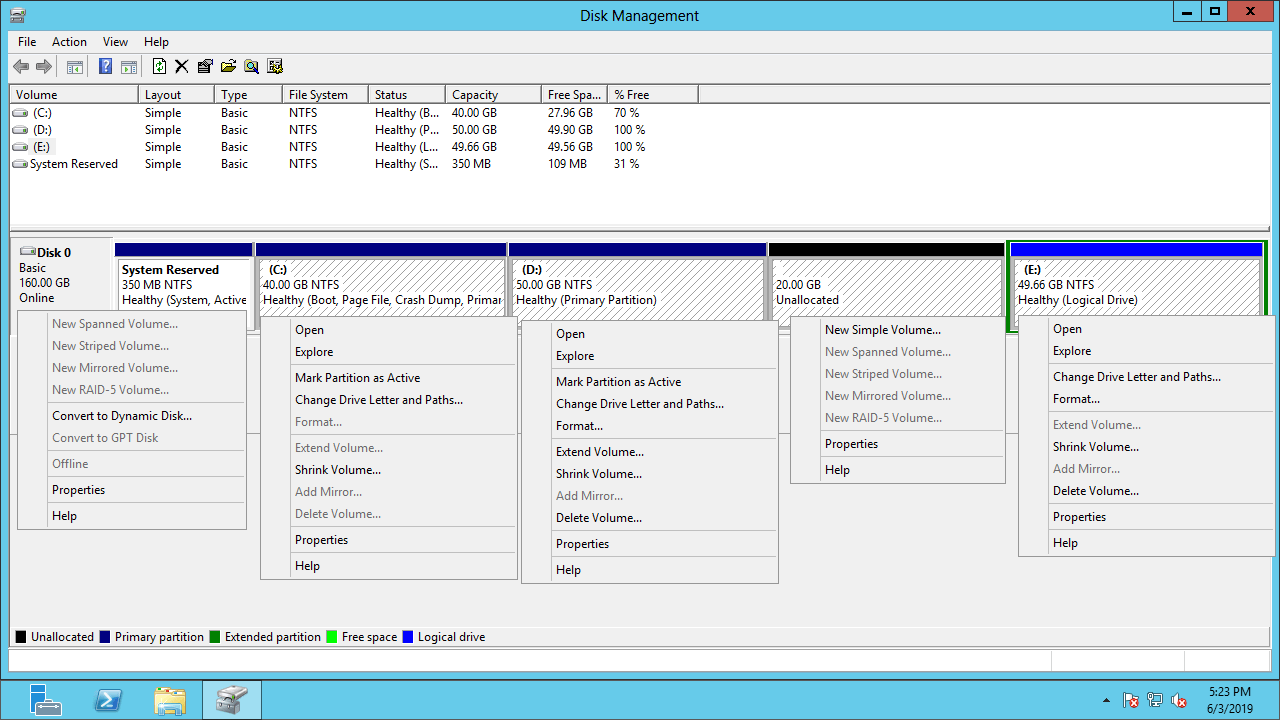
For an allocated partition:
- Open root directory with File Explorer
- Mark partition as Active
- Change drive letter and path
- Format partition
- Shrink a volume and generate unallocated space on the right side.
- Extend a volume with unallocated space behind it.
- Delete partition
- Add mirror
If you select Add Mirror, both disks will be converted to dynamic.
For dynamic disks:
Disk Management can create Simple, Mirrored, Spanned, Striped, and RAID-5 volumes.
To create a RAID 5 volume, there must be at least 3 dynamic disks. If there are only two disks available, this option is greyed out.
Although Windows Disk Management has this capability, it is not recommended to use dynamic disk volumes, because:
- It consumes many server resources and degrades performance.
- Many software applications do not support dynamic disk volumes.
- Hard disks and RAID controllers are much cheaper now.
How to Shrink Partition with Disk Management in Server 2012
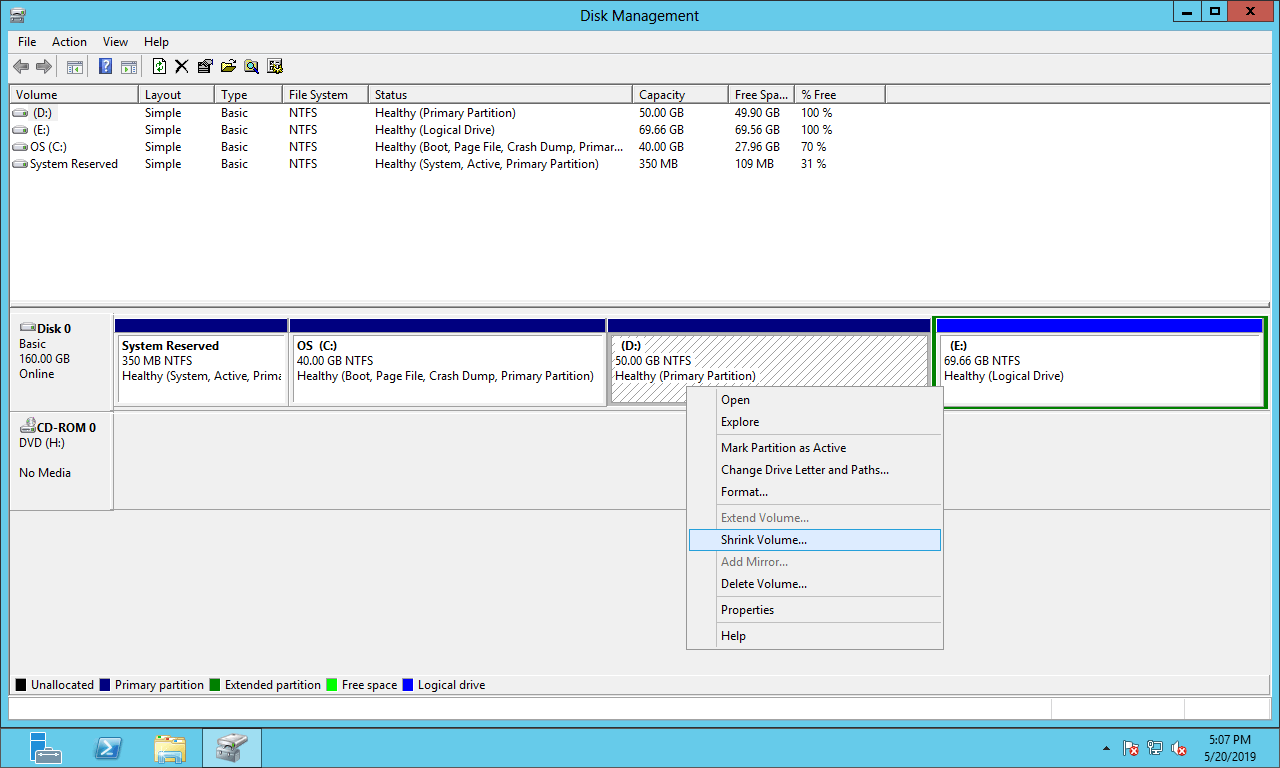
One of the useful features of Disk Management is "Shrink Volume", which is able to decrease an allocated partition without losing data. Unallocated space released from this partition can be used to create a new volume.
- Press Windows and X on the keyboard, click "Disk Management" in the list.
- Right click a partition (such as D:) and select "Shrink Volume".
- Enter an amount of space and click "Shrink" in the pop-up window.
Note:
- Only NTFS partitions are supported.
- Unallocated space can only be generated on the right side when shrinking a partition.
How to Extend Partition with Server 2012 Disk Management
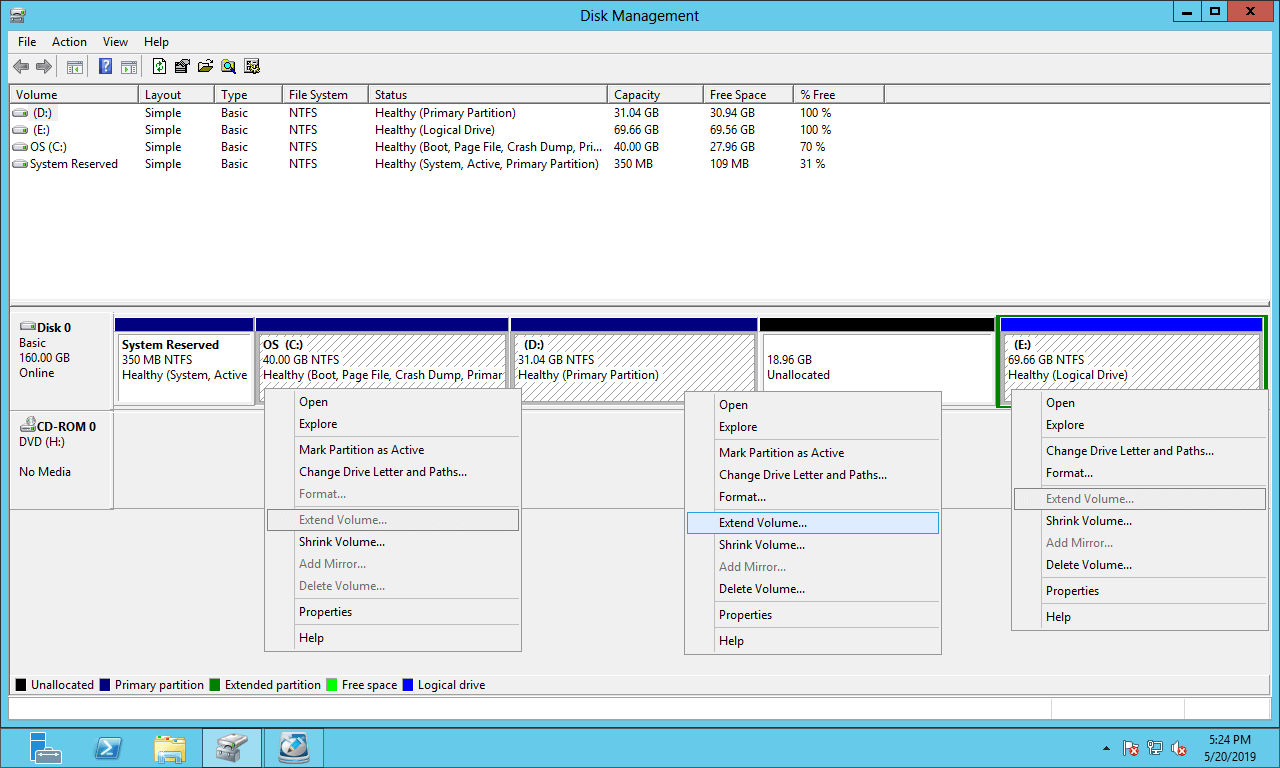
- Right click the partition that has adjacent unallocated space on the right, and then select "Extend Volume".
- Simply click Next till Finish in the pop-up "Extend Volume Wizard" window.
Note:
- Only NTFS partitions are supported.
- The Extend Volume function only works when there is contiguous unallocated space on the right. You cannot get such required space by shrinking another volume in Disk Management. This is why many users report that Extend Volume is greyed out in Server 2012 after shrinking a partition.
Disadvantages of Windows Server 2012 Disk Management
Compared with the Windows Server 2012 native Disk Management tool, NIUBI Partition Editor has more advantages while resizing disk partitions:
- It can shrink and extend both NTFS and FAT32 partitions.
- It can generate unallocated space on either the left or right side when shrinking a volume.
- It can merge unallocated space into either contiguous partition in 1 step.
- It can move and merge unallocated space into any non-adjacent partitions.
- It can merge 2 contiguous partitions in 1 step.
How to shrink, move and extend partition in Windows Server 2012:
Besides shrinking and extending partitions, NIUBI Partition Editor helps perform many other disk and partition management operations in Windows Server 2012, 2016, 2019, 2022, 2025 and previous Server 2003/2008.
What Does NIUBI Partition Editor Do?
For unallocated space:
- Create one or more volumes
- Wipe data in it
- Surface test (scan bad sectors)
- View properties (detailed parameters)
For an entire disk:
- Initialize
- Change status to offline or online
- Set read-only attribute
- Wipe disk (cannot be recovered)
- Surface test
- View properties
- Clone disk to migrate data and OS
- Convert MBR disk to GPT
- Delete all partitions
- Cleanup disk
For a single partition:
- Resize volume (shrink and extend)
- Move location
- Merge two adjacent volumes by 1 step
- Copy a partition quickly
- Convert to Logical or Primary partition
- Optimize file system
- Convert NTFS to FAT32
- Change drive letter (such as D:)
- Change label (add a name or modify)
- Set as Active
- Check file system integrity
- Defrag to improve performance
- Hide from File Explorer
- Delete (files can be recovered)
- Format volume to use as new
- Wipe (erase data permanently)
- Surface test
- Explore (view files/folders with directory)
- View properties
Compared to other disk management tools for Windows 2012 server, NIUBI Partition Editor is much safer and faster because of its powerful technologies:
- Hot Clone - Clone disk partitions in Windows for backup, migration, and fast disk swapping.
- Virtual Mode - All operations are listed as pending for preview, and real disk partitions won't be modified until you click "Apply" to confirm.
- Cancel-at-Will - If you applied incorrect operations, you can safely cancel the ongoing operations at any stage before completion.
- 1 Second Rollback - If any error is detected while resizing partitions, it can immediately and automatically revert the disk partitions to their previous state.
- Advanced File-Moving Algorithm: Resize and move partitions 30% to 300% faster, saving significant time, especially when handling a large number of files.
 © 2009 - NIUBI Technology All Rights Reserved. |