
Compared to data volumes, system partition C is very likely to get full after running the server for a period of time. Even if you installed all programs to another volume, there is still a large amount of junk files generated in the system volume. If you contact support from server OEM manufacturers, they will tell you to back up everything, delete and recreate all partitions, and finally restore and verify your data. If you do that, your whole weekend may be wasted. Instead, you can resize/extend the system partition in a Windows 2012 server with a safe tool. This article introduces how to extend the system volume in Windows Server 2012 R2 without losing data, quickly and easily.
Tips Before Resizing the System Partition in Server 2012 R2
1. Take Care of the System and Data
Unlike read-only data programs such as file recovery software, partition manager software will modify disk partitions. Therefore, there is a potential risk of system damage and data loss, especially when you are resizing the system partition. It takes a long time to restore everything, even if you have a backup. So, it is very important to use a safe tool.
Better than other tools, NIUBI Partition Editor has powerful technologies to protect your system and data.
- Virtual Mode - All operations are listed as pending for preview; real disk partitions will not be changed until you click "Apply" to confirm.
- Cancel-at-Will - If you applied the wrong operations, you can cancel the ongoing operations without destroying data and partitions.
- 1-Second Rollback - If any error is detected while resizing a partition, it automatically reverts the server to its original status in a flash.
- Hot Clone - Clone a disk partition in Windows without server interruption.
It is 30% to 300% faster because of the advanced file-moving algorithm. This is very helpful when shrinking and moving a partition with a large number of files, especially when the operations require a server reboot.
2. About Hardware RAID Arrays
A hardware RAID array has advanced capabilities; it is realized by a RAID controller with several disks. But to the Operating System and NIUBI Partition Editor, there is no difference whether you use an SSD, HDD, or any type of hardware RAID array. When extending the system volume in Server 2012 R2, do not break the RAID array or perform any operations on the RAID controller; follow the same steps below.
3. Select the Corresponding Solution According to Your Own Partition Layout
- In most servers, there is at least one data volume on the system disk; you just need to shrink it to get some Unallocated space and add it to the C drive.
- If you want to shrink any nonadjacent partition to extend the system drive, there is an additional step to move the Unallocated space to the left before adding it to the C drive.
- If there is no other partition or not enough free space on the system disk, no partitioning software can help you extend the system partition by adding free space from another separate disk. In that case, you can clone the Server 2012 disk to a larger one and extend the partition with the extra disk space. If you do not want to copy the whole disk, you can move a partition on the system disk to another one, delete it, and then add the disk space to the C drive.
How to Extend the System Partition in Windows Server 2012 R2
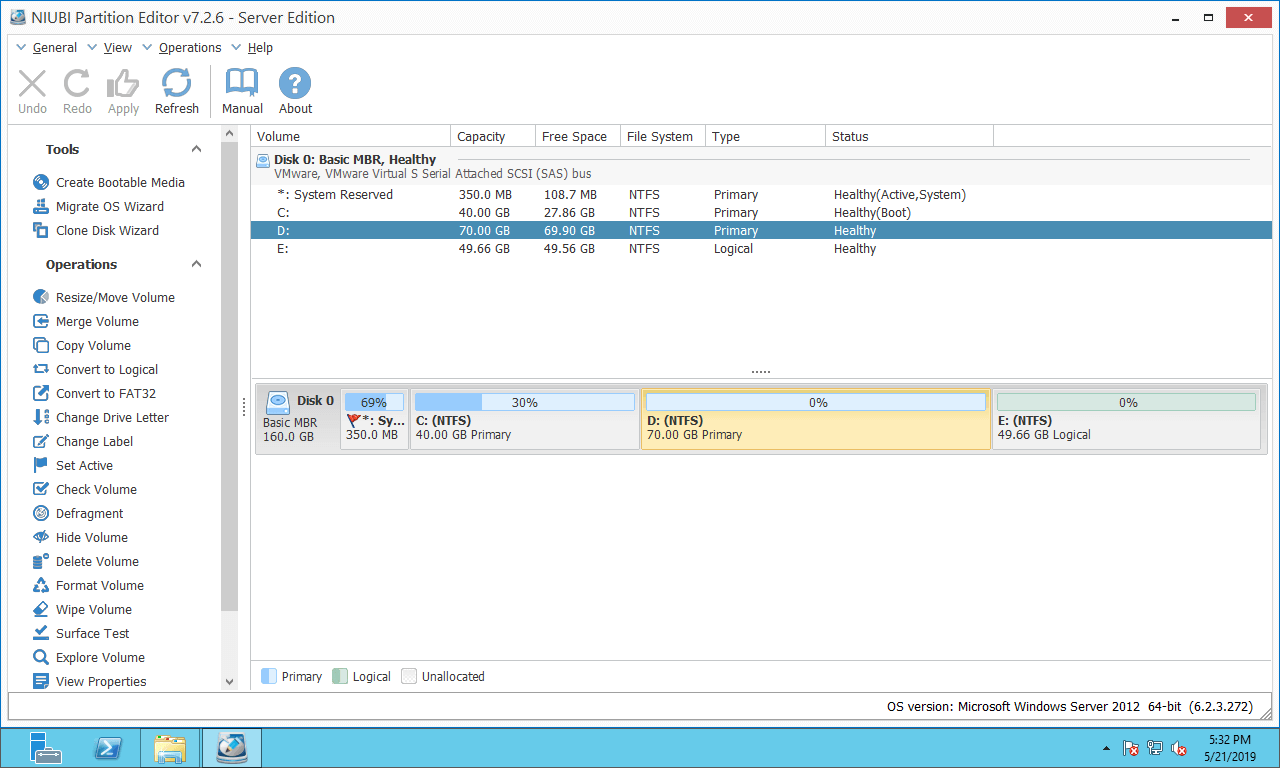
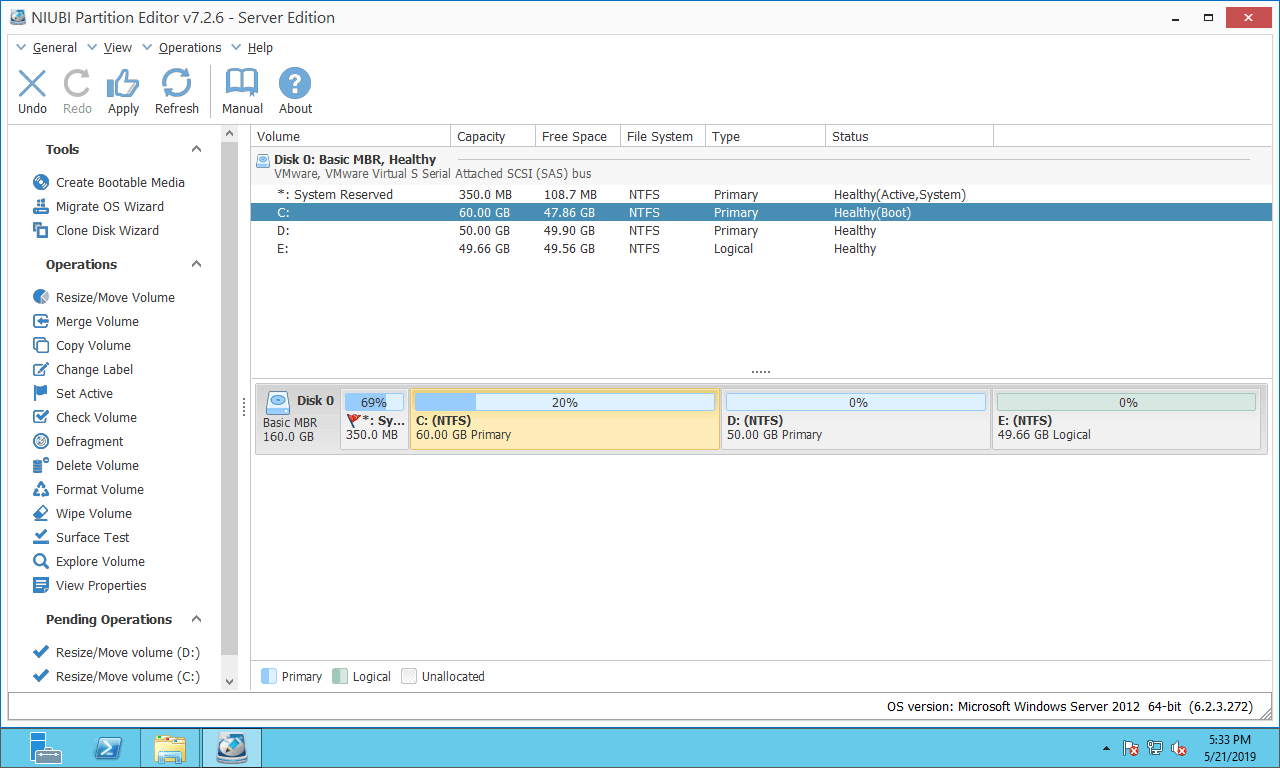
Download NIUBI Partition Editor, and you will see all disks with their partition layouts on the right. Available operations for the selected disk or partition are listed on the left and can be accessed by right-clicking.
① Extend the System Partition with a Contiguous Volume
In most servers, there is plenty of free space in the contiguous partition D (or E). In that case, shrink D to make Unallocated space on the left, and then add the Unallocated space to the C drive.
Steps to extend the system volume in Server 2012 R2 with free space in D (adjacent volume):
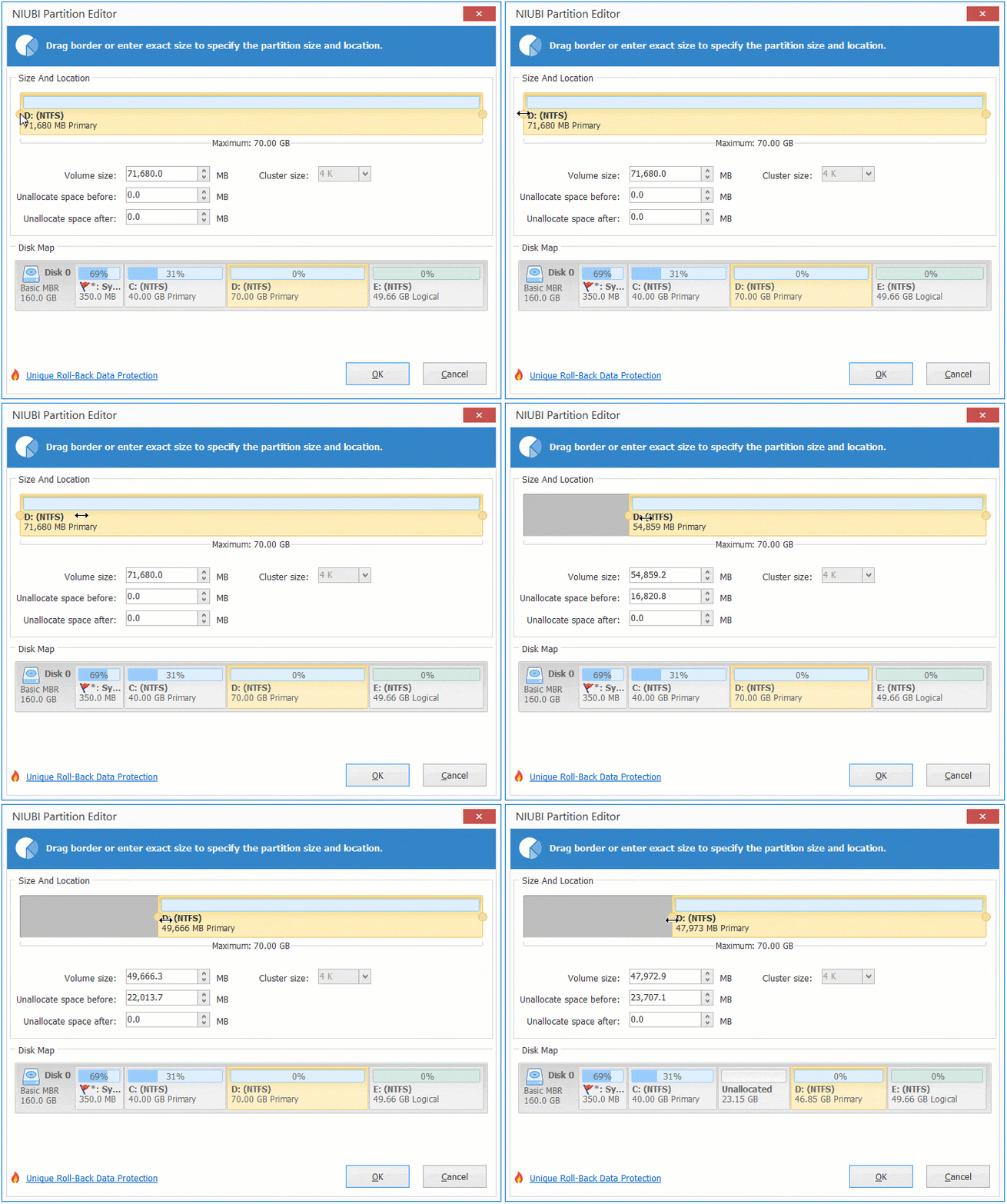
- Right-click the D: drive and select "Resize/Move Volume". Drag the left border rightward in the pop-up window, or enter an amount in the "Unallocated space before" box. Then, a portion of the free space in drive D will be changed to Unallocated on the left.
![Shrink D]()
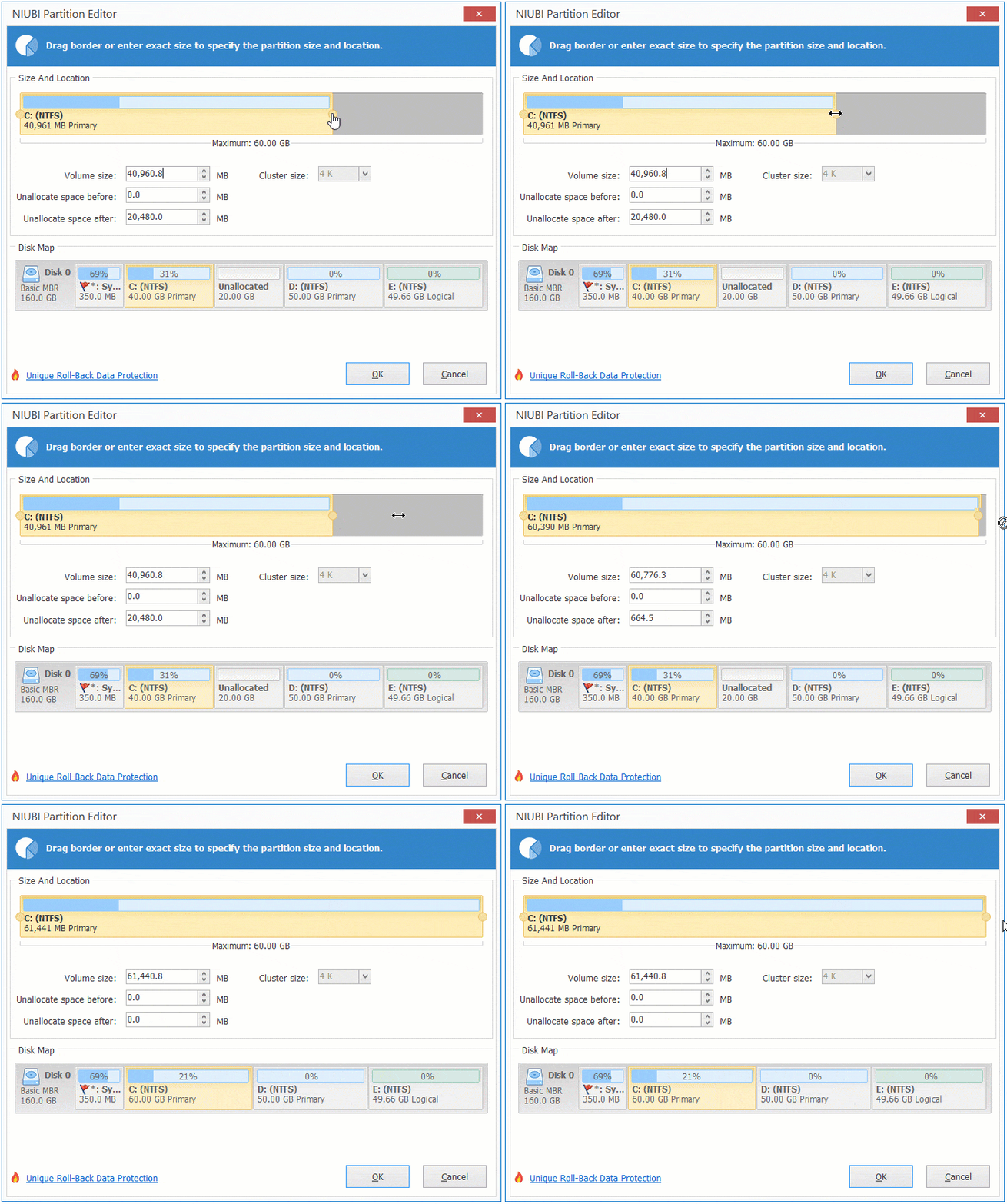
- Right-click the system partition C: and select "Resize/Move Volume" again. Drag the right border rightward to combine this Unallocated space.
![Extend C]()
- Click the Apply button on the top left to take effect, and you are done. (All operations before this step only work in virtual mode.)
![C drive extended]()
② Extend the System Partition with a Nonadjacent Volume
If there is insufficient free space in the contiguous partition D, you can shrink a nonadjacent partition on the same disk. Because the D drive is in the middle, the Unallocated space shrunk from E is nonadjacent to the C drive. You should move the Unallocated space next to the C drive in advance; otherwise, you cannot extend the C drive.
How to extend the system partition in Windows Server 2012 R2 with a nonadjacent volume:
- Right-click drive E: and follow Step 1 above to make Unallocated space on the left side.
- Right-click drive D: and select "Resize/Move Volume". Put the mouse pointer in the middle of the D drive and drag it rightward in the pop-up window. Then, the Unallocated space will be moved to the left.
- Right-click the system partition C: and use "Resize/Move Volume" to combine this Unallocated space.
How to extend the system drive in Server 2012 R2:
③ Extend the System Partition with Another Disk
In a few servers, there is only a C drive on the system disk. In some servers, there is another volume on the same disk, but there is no available free space. As stated above, you cannot add space from another separate disk with any software. In that case, you have 2 options:
1. Copy the system disk to a larger one and expand the partition with the extra disk space:
2. Move a volume to another disk, delete it, and add its space to the system C drive:
Extend the System Volume for a Server 2012 VM in VMware/Hyper-V
To save costs or for other benefits, many companies run Windows Server 2012 as a virtual machine. If you want to extend the system partition in a Server 2012 VM in VMware or Hyper-V, first check if there is available free space in any other volume on the same virtual disk. If yes, simply install NIUBI Partition Editor in the virtual machine and follow the steps in the videos above.
If the entire virtual disk is full and there is no available free space, you can expand the virtual disk in VMware/Hyper-V. After expanding the disk, the additional space will be shown as Unallocated at the end of the original virtual disk, and then you can extend the system C drive with this additional Unallocated space.
In Summary
To extend the system partition in Windows Server 2012/2016/2019/2022/2025, you had better back up or clone the disk first and run safe partition software. Because of its powerful data protection technologies, NIUBI Partition Editor helps you complete this task quickly and safely. Follow the corresponding solution according to your own disk partition configuration. Besides shrinking, moving, and extending partitions, it helps you perform many other disk partition management operations.
 © 2009 - NIUBI Technology All Rights Reserved. |