
When the system partition C runs out of space, if you contact server manufacturers, they'll tell you to back up everything, recreate partitions, and restore from a backup. This process is highly time-consuming and disruptive. Many server administrators ask if it is possible to increase the C drive space in Windows 2012 server without losing data. The answer is yes, but you had better make a backup in advance and run a safe partition tool, because there is a potential risk of system damage and data loss with unreliable software. This article introduces how to increase the C drive space in Windows Server 2012 R2 with the best disk partition tool.
Which Tool to Increase C Drive Space in Server 2012 R2
Many people think that Windows' native tools have the best compatibility because they are safer. However, this is not the case, at least when adjusting partition sizes. Similar to previous versions, Windows Server 2012 has a native "Disk Management" tool. Besides creating, deleting, and formatting partitions, it is able to decrease and increase partition sizes. It is safe to extend a partition, but it is unreliable to shrink a partition. There is a potential risk of partition damage when shrinking partitions with it, especially if there are both primary and logical partitions on a disk.
Although there is an "Extend Volume" function in Disk Management, it is unable to extend the C drive by shrinking another volume. To illustrate this, in the screenshot below, the D drive has been shrunk.
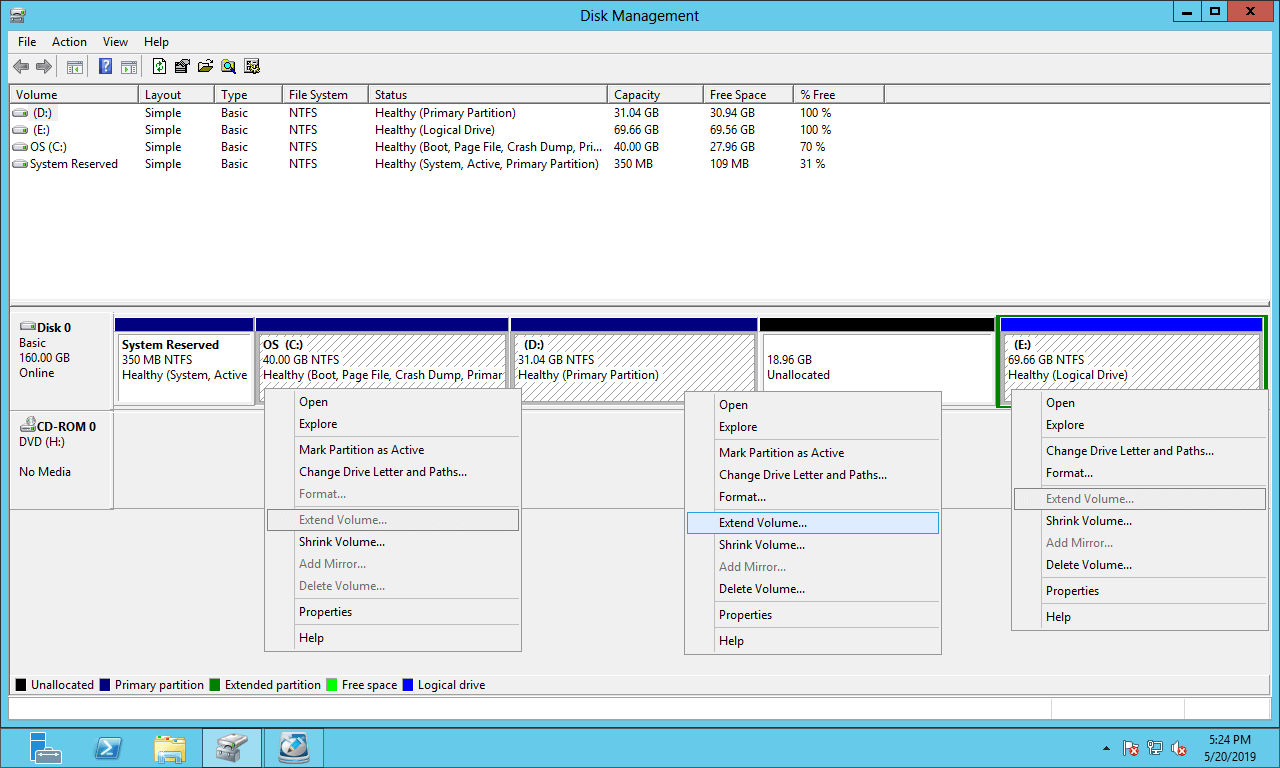
As shown in the screenshot, "Extend Volume" is disabled for the C: and E: drives after shrinking D, this is because:
- The Disk Management "Shrink Volume" function can only create unallocated space on the right when shrinking a partition.
- The "Extend Volume" function can only merge unallocated space into the left contiguous partition.
After shrinking the D drive, the unallocated space is non-adjacent to the C drive and on the left of the E drive. Therefore, "Extend Volume" doesn't work.
If you want to increase the C drive free space in Windows Server 2012 R2 without third-party software, the only option is deleting the adjacent partition on the right of the C drive.
- If you installed programs or any services to this adjacent partition, do not delete it.
- This adjacent partition D (or E) must be a primary partition. If it is a logical drive, Disk Management cannot extend the C drive even after deleting this partition.
- Another Diskpart command tool has the same restrictions.
To increase the C drive space in Server 2012 R2, third-party disk partition software is much more powerful. Because they are able to:
- Resize both NTFS and FAT32 partitions.
- Shrink a partition and create unallocated space on either the left or right side.
- Merge unallocated space into either contiguous partition in 1 step.
- Move and merge unallocated space into any non-adjacent partition on the same disk.
There are many server partition tools on the market, but few can ensure your system and data remain intact. Compared with other tools, NIUBI Partition Editor is much safer and faster because of its innovative technologies:
- Hot Clone - Clone disk partitions in Windows for backup, migration, and fast disk swapping.
- Virtual Mode - All operations are listed as pending for preview, and real disk partitions won't be modified until you click "Apply" to confirm.
- Cancel-at-Will - If you applied incorrect operations, you can safely cancel the ongoing operations at any stage before completion.
- 1 Second Rollback - If any error is detected while resizing partitions, it can immediately and automatically revert the disk partitions to their previous state.
- Advanced file-moving algorithm: Resize and move partitions 30% to 300% faster, saving significant time, especially when handling a large number of files.
Increase C Drive Space from D or Another Volume on the Same Disk
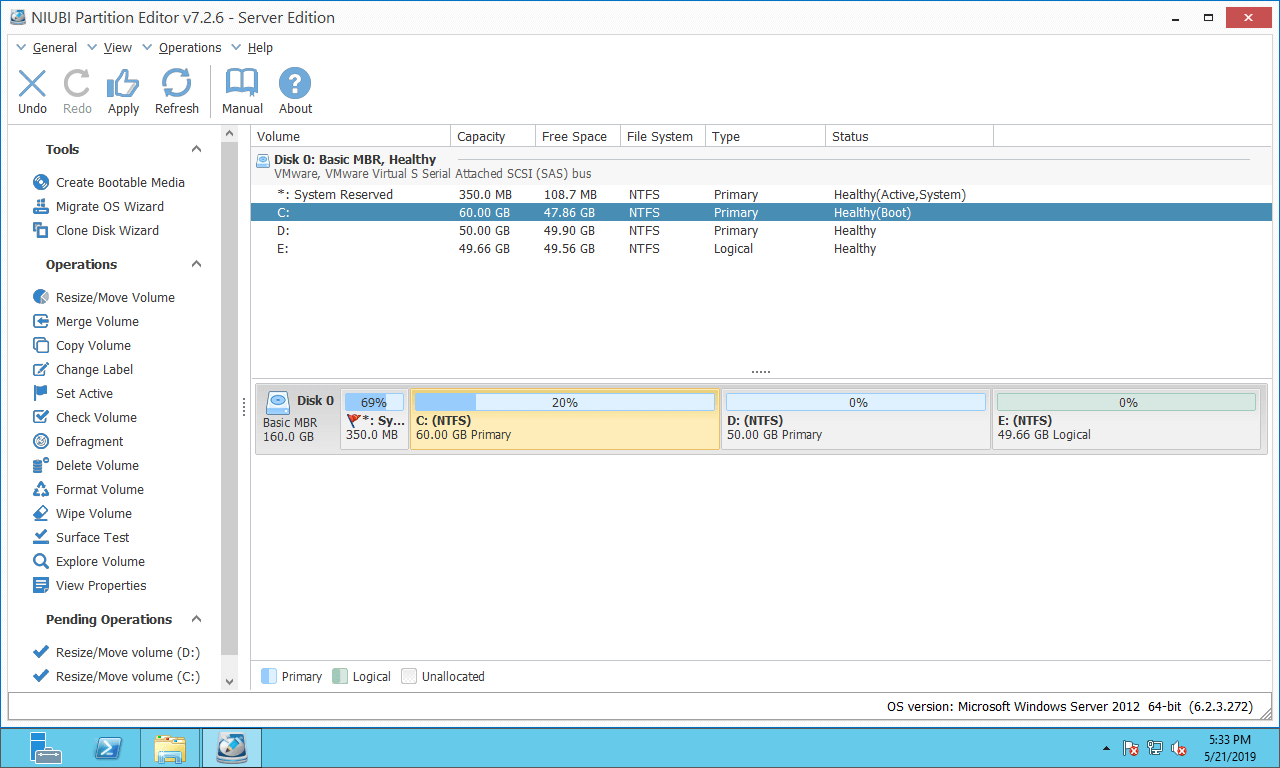
In most cases, there is free space in another partition on the same disk. You can shrink a partition to get unallocated space and then add it to the C drive. No partition will be deleted. The operating system, programs, and associated settings, as well as everything else, remain exactly the same as before. All you need to do is drag and drop on the disk map.
Note: if you use any types of hardware RAID arrays, do not break the array or perform any operations on the RAID controller. There is no difference whether you use an SSD, HDD, RAID array, or run Windows Server 2012 as a virtual machine in VMware/Hyper-V.
How to increase the C drive space in Windows Server 2012 R2 without losing data:
- Download NIUBI Partition Editor, right-click the contiguous partition D (or E) and select "Resize/Move Volume". Drag the left border to the right in the pop-up window. Then this partition will be shrunk and unallocated space will be created on the left.
- Right-click the C: drive and run "Resize/Move Volume" again, drag the right border to the right in the pop-up window. Then the unallocated space will be added to the C drive.
- Click OK to return to the main window, then click "Apply" on the top left to execute the changes.
If you want to get free space from a non-adjacent partition such as E: on the server, there is an additional step to move unallocated space before adding it to the C drive.
Watch the video on how to increase the size of the C: drive in Server 2012 R2:
Increase C Drive Free Space with Another Hard Disk
The size of a physical disk is fixed, so no partitioning software can increase the C drive space in Windows 2012 server by moving free space from another disk. The free space must be transferred inside the same disk. If there is only a C: drive on the system disk, you can copy this disk to a larger one and increase the C drive with extra disk space. Follow the steps in the video:
If there are other partitions on the system disk, besides cloning the disk, you can move a partition to another disk. Then delete this partition and add its disk space to the C drive.
No matter how your disk partition is configured, there is a way to increase the C drive free space in Windows Server 2012 with NIUBI Partition Editor. Select the corresponding method according to your disk partition structure. Besides decreasing and increasing partition size without losing data, this tool helps you perform many other disk and partition management operations.
 © 2009 - NIUBI Technology All Rights Reserved. |