
Partition sizes are allocated while installing Windows or by OEM manufacturers. Many 2012 servers have run for several years, so the original partition structure and sizes often need to be modified. For example: the system partition C or the drive for exchange, database, or backup is running out of space. Then you can resize partitions and add more space to the C drive or another one that is getting full. When resizing a partition in Windows 2012 Server, the first concern should be the safety of both Windows and your data. Nobody likes to see boot failure, partition damage, or data loss. This article introduces how to resize partitions in Windows Server 2012 (R2) with native tools and safe partition software.
Resize Partition with Server 2012 Disk Management
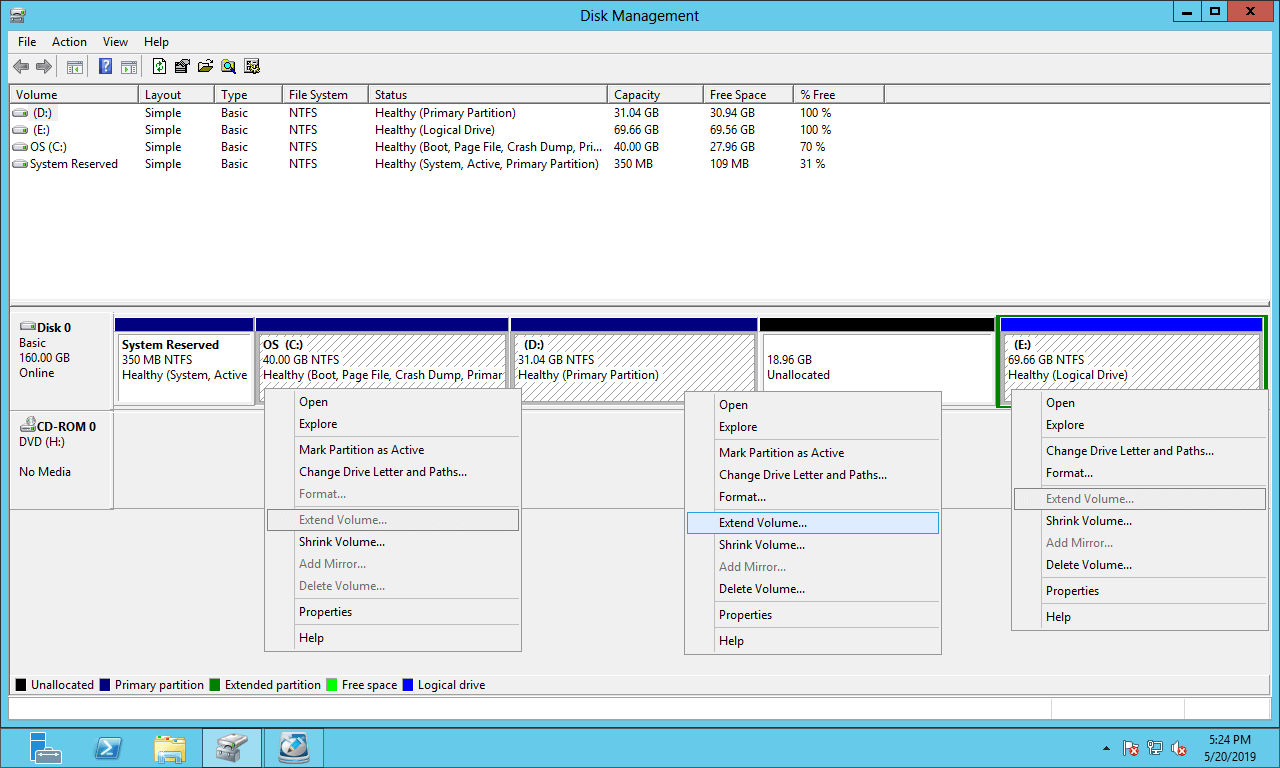
Some users prefer using Windows built-in tools, assuming they offer the best compatibility and security. If you want to resize a Server 2012 partition, there is indeed a native tool - Disk Management, which has Shrink Volume and Extend Volume functions to help decrease and increase partition size.
How to resize partition in Server 2012 R2 with Disk Management:
Press Windows and X on the keyboard, and then click Disk Management from the list.
To shrink a partition:
- Right-click an NTFS partition and select Shrink Volume.
- Enter an amount of space and click Shrink.
To extend a partition:
- Right-click the partition with adjacent unallocated space and click Extend Volume.
- Simply click Next till Finish in the pop-up Extend Volume Wizard window.
It seems very easy to resize Server 2012 partitions, but Disk Management cannot extend a partition by shrinking another one, because it has many restrictions:
- It can only shrink a volume toward the left and generate unallocated space on the right side.
- Only the partition with adjacent unallocated space on the right side can be extended.
- Only NTFS partitions can be shrunk and extended; other types of partitions are not supported.
Other disadvantages to resizing partitions with Server 2012 Disk Management:
- If there are unmovable files located in a partition, Disk Management can only shrink it with little space.
- If partition D is logical, the C: drive still cannot be extended after deleting it.
Adjust Partition Size in Server 2012 with Partition Software
With disk partition software, there are no such restrictions; you just need to drag and drop on the disk map to resize partitions. Compared with other software, NIUBI Partition Editor is much safer and faster because of its unique technologies:
- Virtual Mode - all operations you performed are listed as pending for preview; real disk partitions will not be modified until you click "Apply" to confirm.
- Cancel-at-Will - if you applied incorrect operations, you can cancel the ongoing operations at any stage before completion.
- 1-Second Rollback - if any error is detected while resizing partitions, it can immediately and automatically revert the disk partitions to their previous state.
- Hot Clone - clone disk partitions without server interruption; you can clone the system disk before any operation or regularly as a backup, and boot from the cloned disk immediately whenever the system disk fails.
- Advanced file-moving algorithm - resize and move partitions 30% to 300% faster.
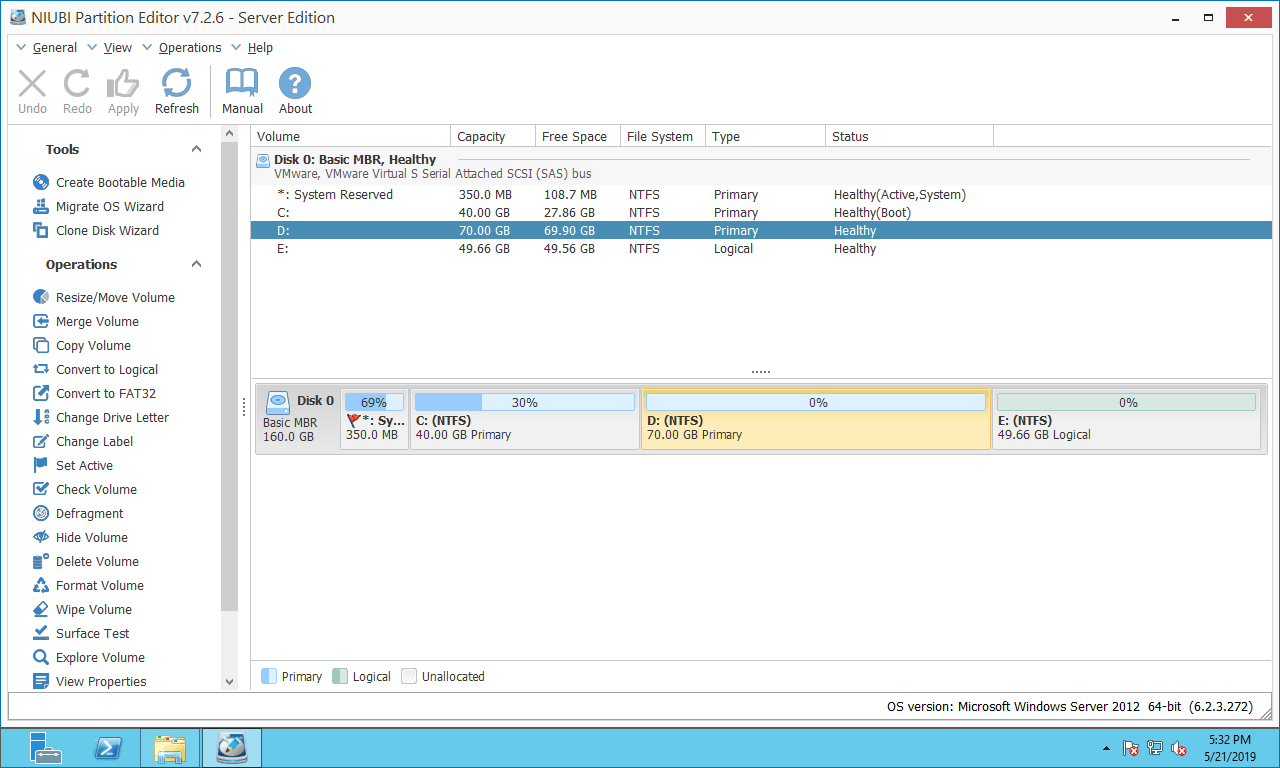
Download NIUBI Partition Editor and you will see all disk partitions with structure and other information. There are C, D, E, and System Reserved partitions on Disk 0. The original C: drive is 40GB and D: is 70GB.
How to resize partition D to expand C in Windows Server 2012 R2:
Step 1: Right-click the D: drive and select "Resize/Move Volume", then drag the left border to the right in the pop-up window. (Or enter an amount in "Unallocated space before")
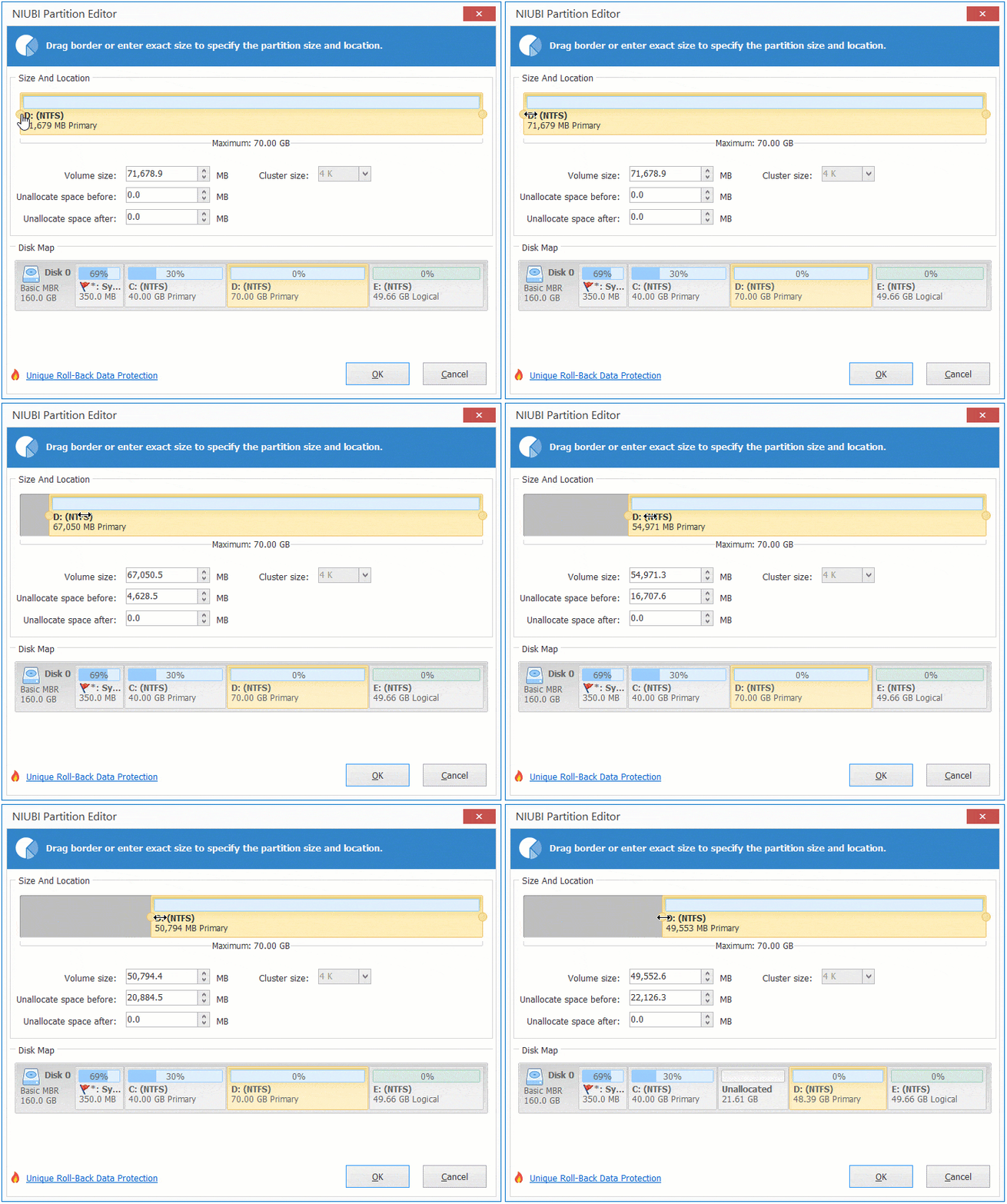
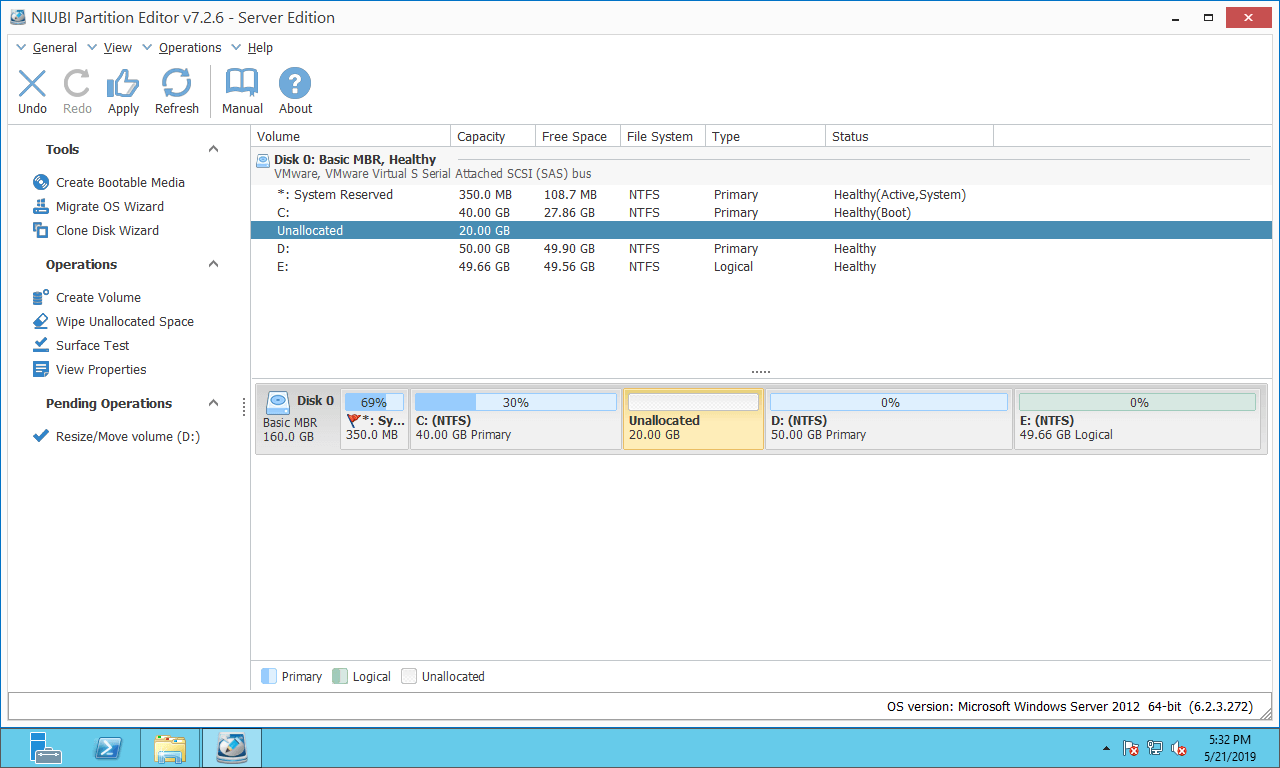
Then, the D drive is shrunk to 50GB, and 20GB of unallocated space is generated on the left side.
Step 2: Right-click the system partition C: and select "Resize/Move Volume" again, then drag the right border to the right to merge this unallocated space.
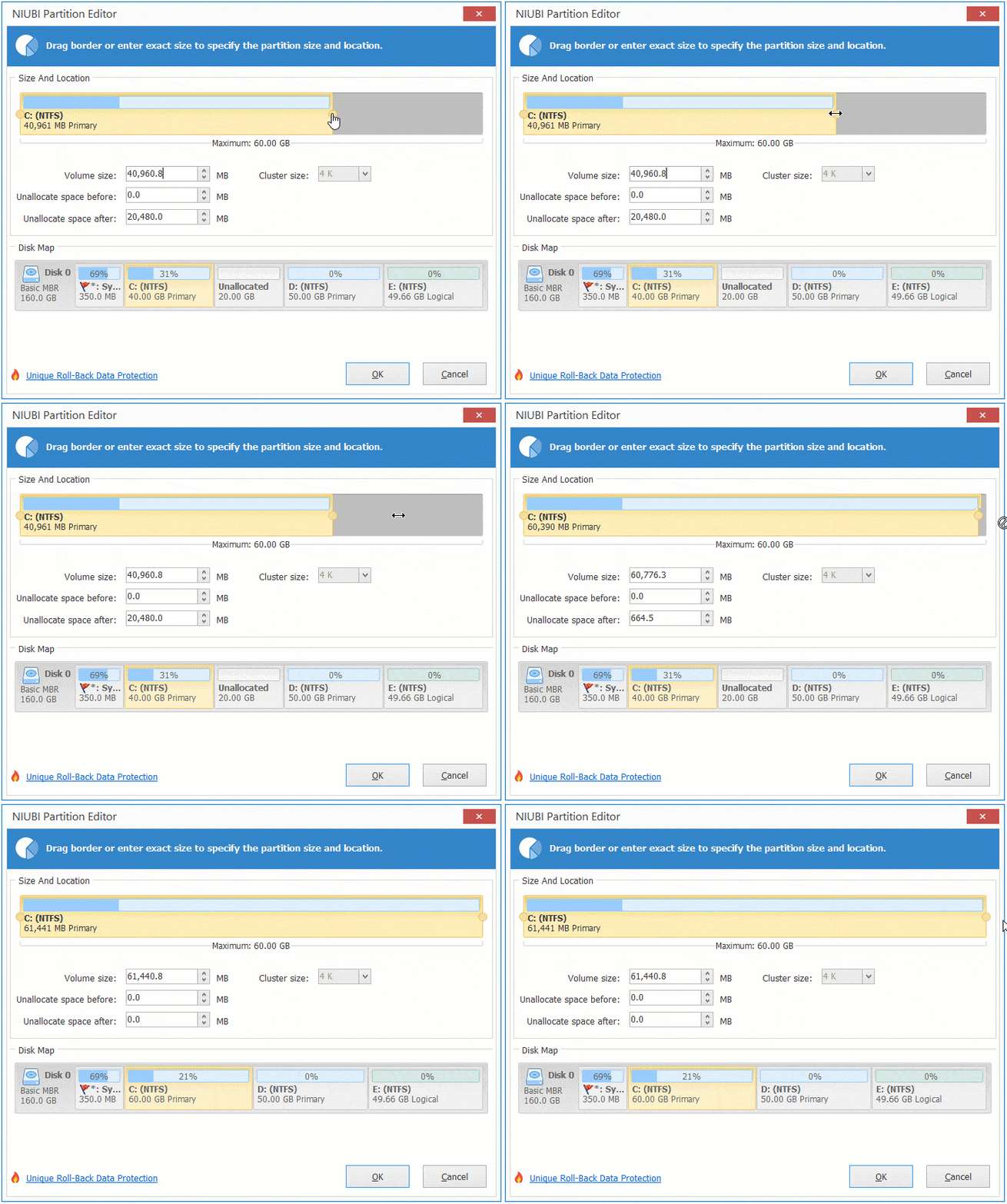
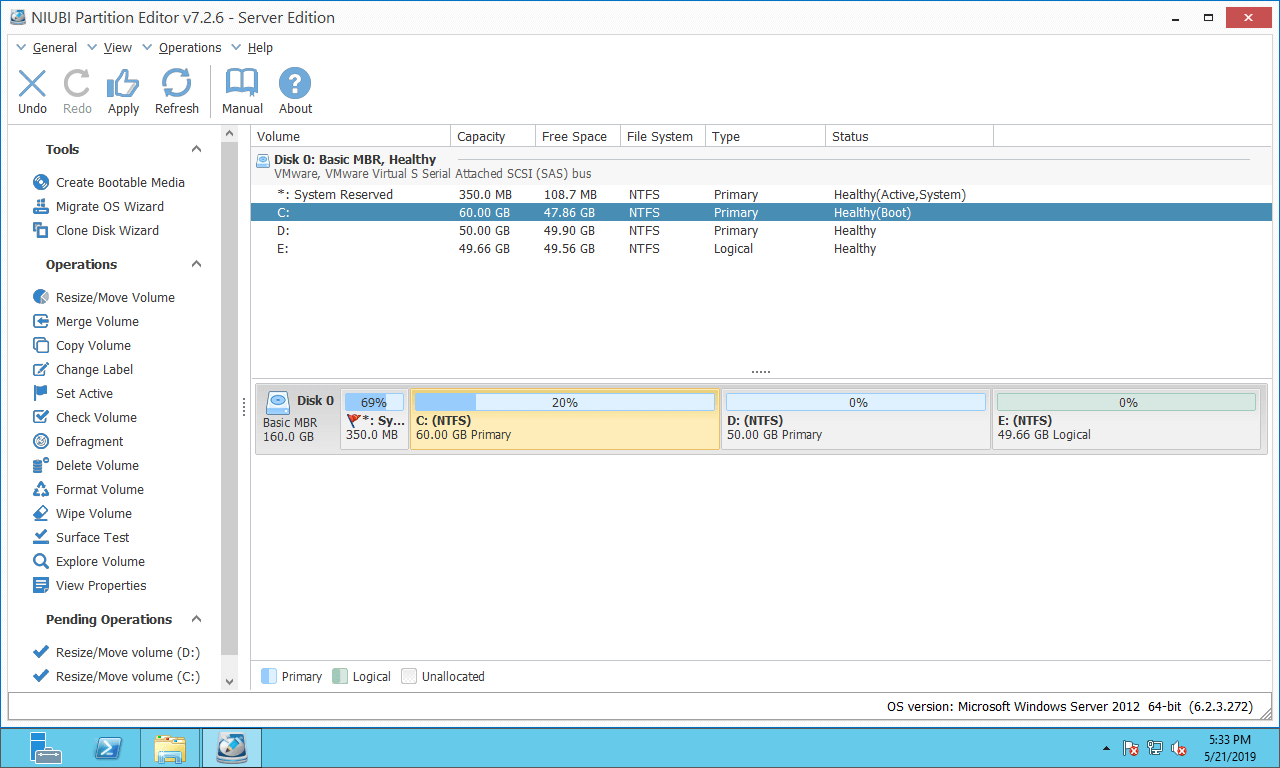
Then the system volume C is resized from 40GB to 60GB.
Step 3:Click "Apply" to confirm and execute.
As long as there is free space in any other partition on the same disk, you can resize the partition and transfer free space to the C drive, no matter if the partitions are contiguous or not, on the left or right side.
Watch the video how to resize partition on Windows Server 2012 R2 without losing data:
Resize Server 2012 R2 Partition with Another Disk
In most cases, follow the steps above and you can resize physical and virtual partitions for local and virtual servers. If you use any types of hardware RAID arrays, there is no difference. Do not break the RAID array or perform any operations to the RAID controller.
However, in some servers, there is no other partition or not plenty of free space on the same disk. No partitioning software can shrink a partition on Disk 1 to extend a partition on Disk 0. In other words, the partitions to be shrunk and extended must be on the same disk.
In that case, you can clone the Server 2012 disk to a larger one and extend the partition with extra disk space. Follow the steps in the video:
In Summary
Disk Management can only help decrease an NTFS partition to create a new volume and increase an NTFS partition by deleting the adjacent one. To resize partitions in Windows Server 2012/2016/2019/2022/2025, NIUBI Partition Editor is a better choice. Besides resizing disk partitions, it helps you merge, copy, convert, defrag, hide, wipe partitions, scan bad sectors, and much more.
 © 2009 - NIUBI Technology All Rights Reserved. |