
Disk partitions are allocated while installing the Operating System, but sometimes you need to change partition size. For example: shrink a large volume to create more partitions, or extend the system C drive when it is getting full. To help resize partitions, Microsoft provides "Shrink Volume" and "Extend Volume" functions in Disk Management starting from Windows Server 2008. However, both functions have many disadvantages. The typical issue is that Disk Management cannot extend a volume by shrinking another one. Windows Server 2012 inherited the same functions without any improvement. Therefore, many users report that they cannot extend the C drive in Server 2012 R2 with Disk Management, even after shrinking or deleting partition D. This article explains why Disk Management is unable to extend the C drive in Windows Server 2012 R2 and how to solve this problem easily.
Why Disk Management Cannot Extend C Drive in Server 2012 R2
Both Shrink and Extend Volume functions support NTFS partitions only. However, it is not an issue for the C drive, because the system partition is formatted with NTFS by default. The most common reasons why you are unable to extend the C: drive in Windows Server 2012 R2 include:
- No contiguous unallocated space on the right
- The adjacent drive (D:) is a logical drive.
Below is a detailed explanation.
Reason 1: No Adjacent Unallocated Space on the Right
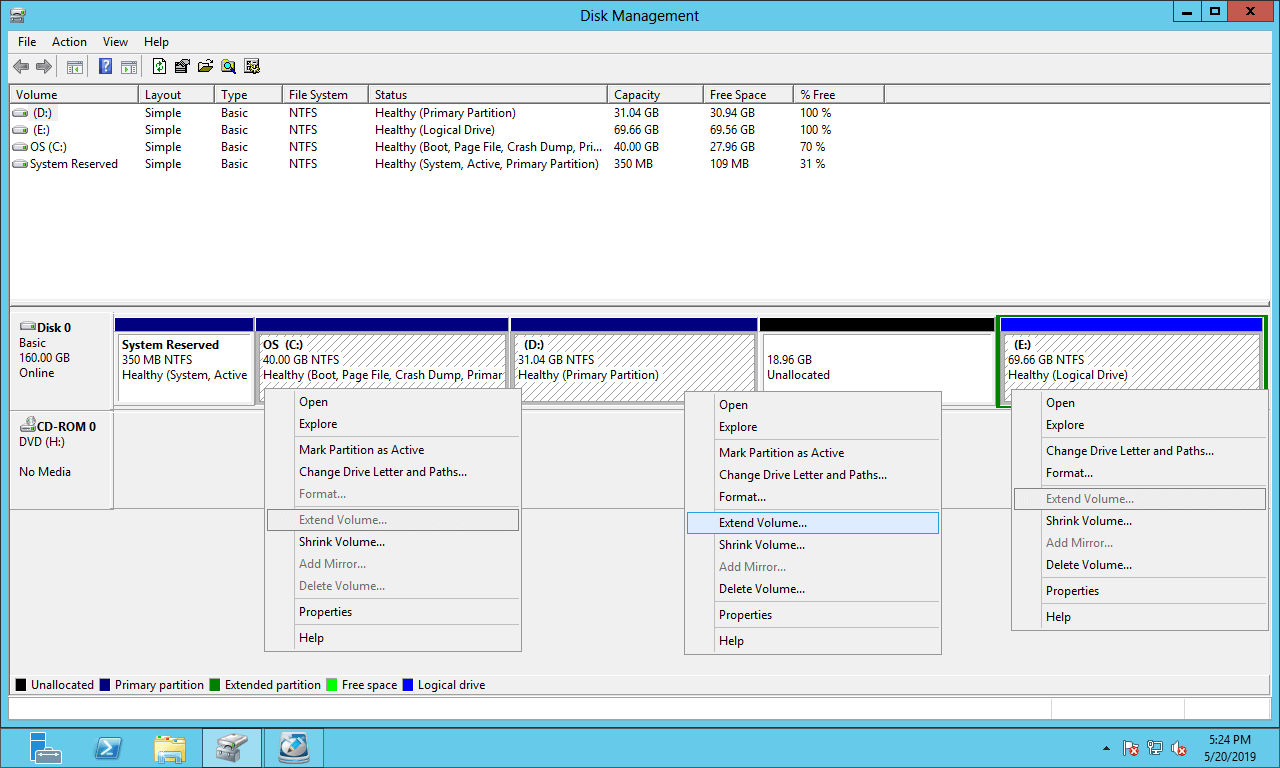
First of all, you should know that the size of a physical disk is fixed; thus, before extending the C drive, there must be unallocated space. Without deleting or shrinking another volume to obtain such space, you cannot extend the C drive with any tool.
Obviously, it is better to get unallocated space by shrinking a volume, because you won't lose files in it. The problem is that you still cannot expand the C drive after shrinking D or other partitions. As shown in the example, Extend Volume is disabled for C drive after shrinking D. This is because:
- "Extend Volume" only works when there is adjacent unallocated space on the right.
- "Shrink Volume" can only generate unallocated space on the right while shrinking a partition.
The unallocated space that was shrunk from the D: drive is non-adjacent to C, so Extend Volume is grayed out. This is the most common reason why you cannot extend the C drive in Server 2012 (R2) with Disk Management.
Reason 2: The Right Contiguous Partition Is Logical
This issue only exists on MBR disks; you can ignore this section if you use a GPT disk.
Because Windows Server 2012 cannot extend the C drive by shrinking another volume, some users wonder if it is possible to delete the D drive to get contiguous unallocated space. The answer is yes if D is a primary partition. If it is a logical drive, you still cannot extend the C drive in Disk Management after deletion.
This is because:
On an MBR style hard disk, you can create a maximum of 4 primary partitions, or 3 primary partitions plus an "Extended partition". The Extended partition works like a container, and all logical drives must reside within it. "Free space" deleted from a logical drive cannot be extended to any primary partition. Likewise, unallocated space deleted from a primary partition cannot be extended to any logical drive.
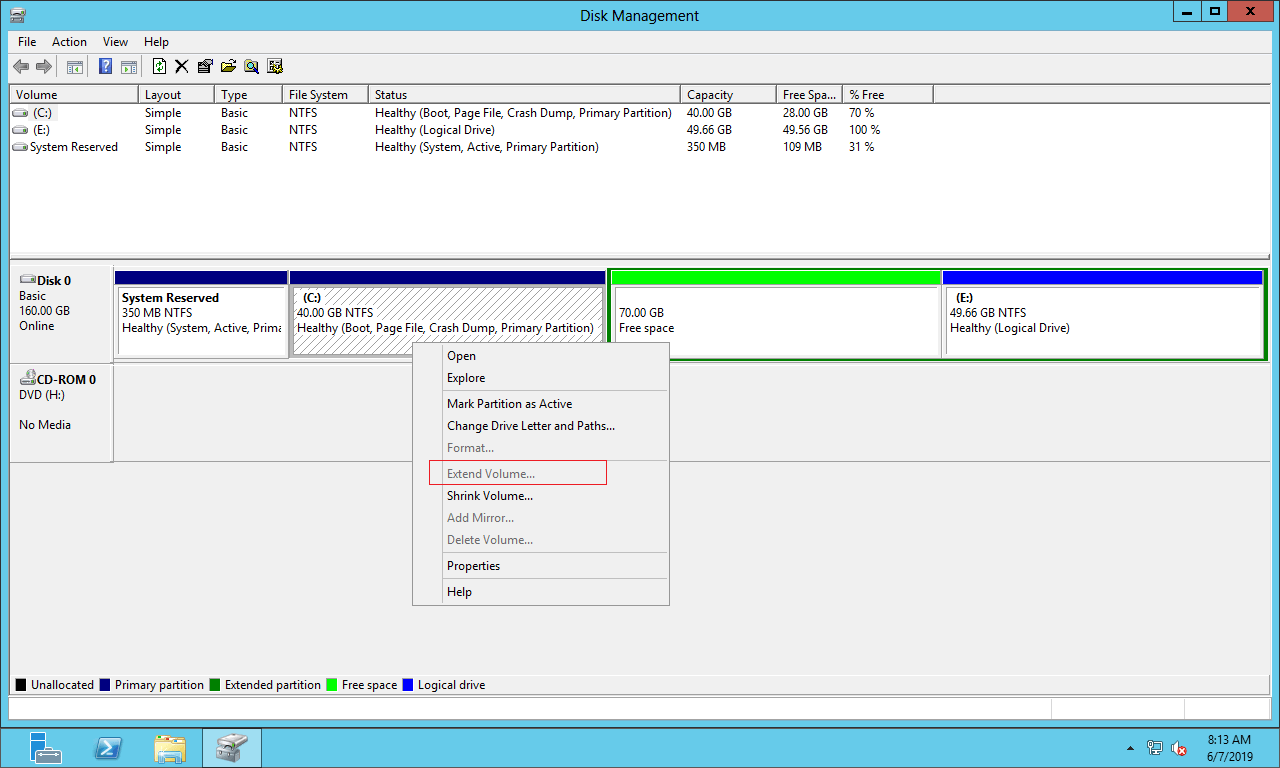
As shown in the example above, the disk space of the D drive is shown as "Free space" instead of unallocated space after deletion. It is still part of the extended partition, so Extend Volume doesn't work. If you want to convert this free space to unallocated space, you must delete all other logical drives and the entire extended partition.
Reason 3: 2TB Restriction on MBR Disk
Because Windows Server 2012 has been running for many years, the original system disks are often small. Some users replaced the system disk with a larger one. If this disk is MBR, you cannot extend the C drive past 2TB, even if there is contiguous unallocated space on the right.
What to Do When Unable to Extend C Drive in Windows Server 2012
With NIUBI Partition Editor, this problem can be solved easily. It is able to combine unallocated or "Free space" into either contiguous partition in one step. When the unallocated space is non-adjacent, it is able to move it and then combine it into other partitions on the same disk.
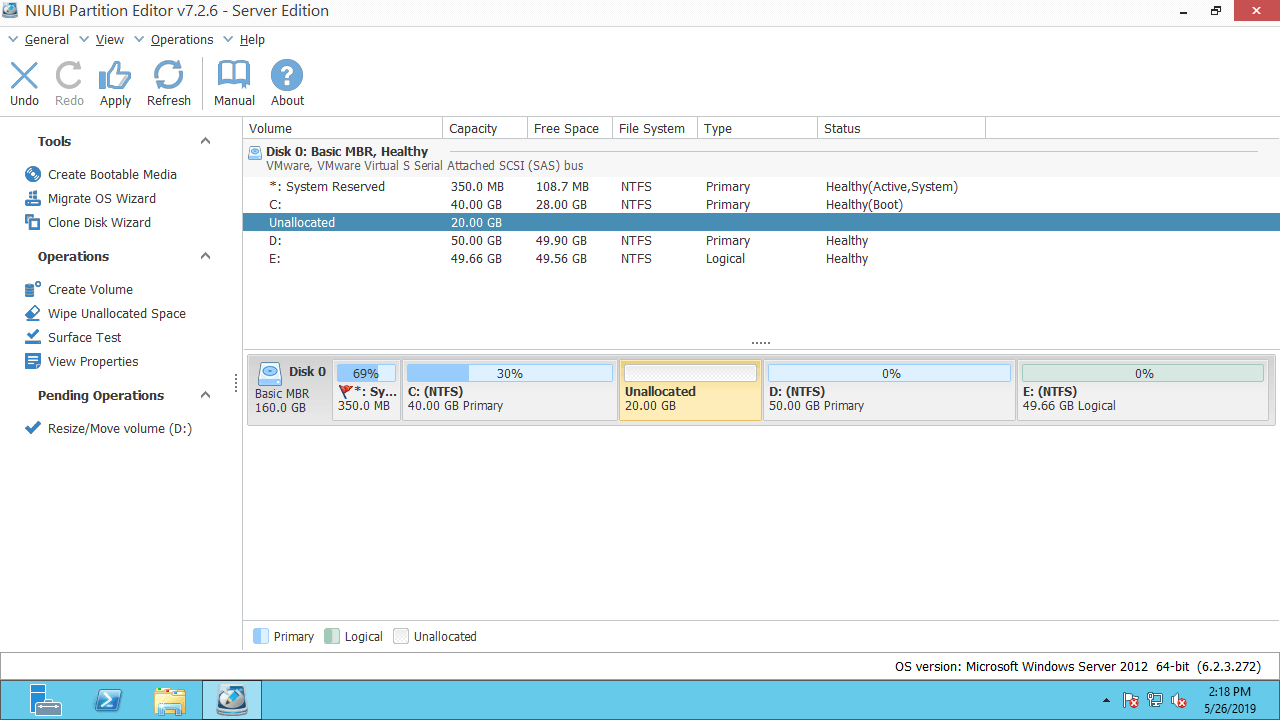
Download it, and you'll see the main window with disk partition structure and other information. In the example below, there is 20GB of unallocated space shrunk from the D drive via Disk Management.
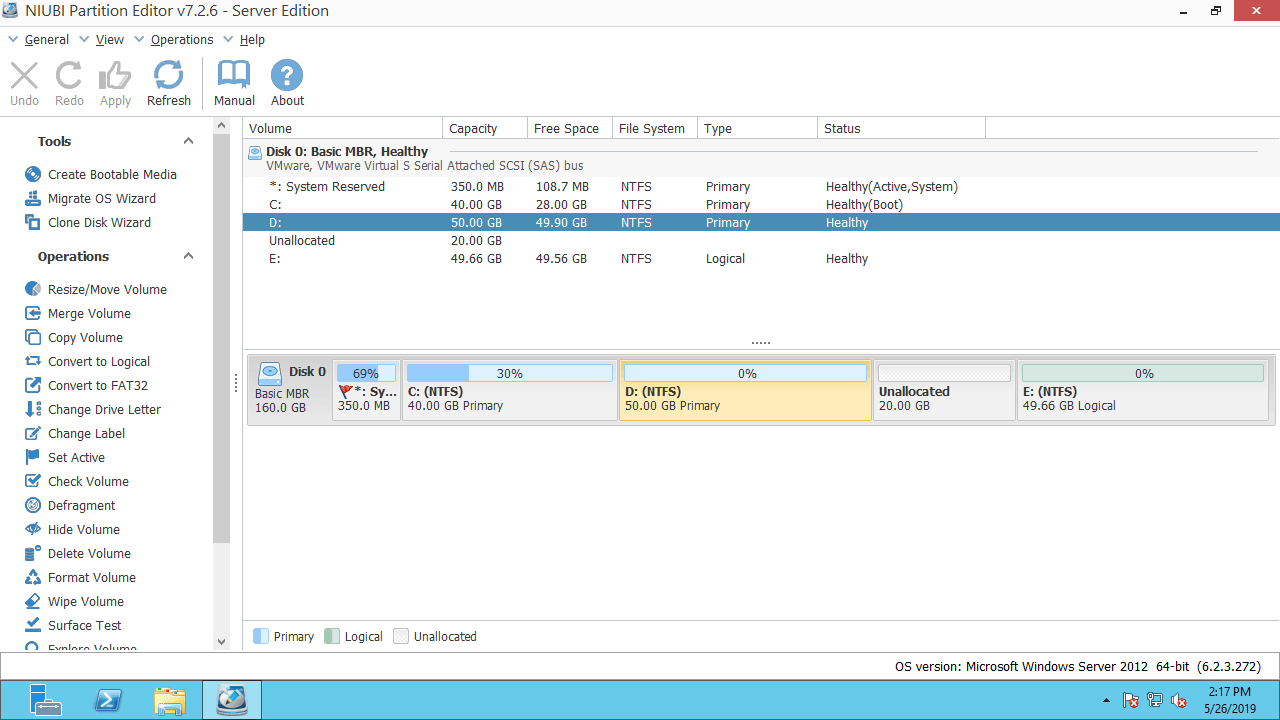
Steps when you are unable to extend C drive in Windows Server 2012 R2 after shrinking D:
Step 1: Right click D: drive and select "Resize/Move Volume", drag the middle of this partition to the right in the pop-up window:
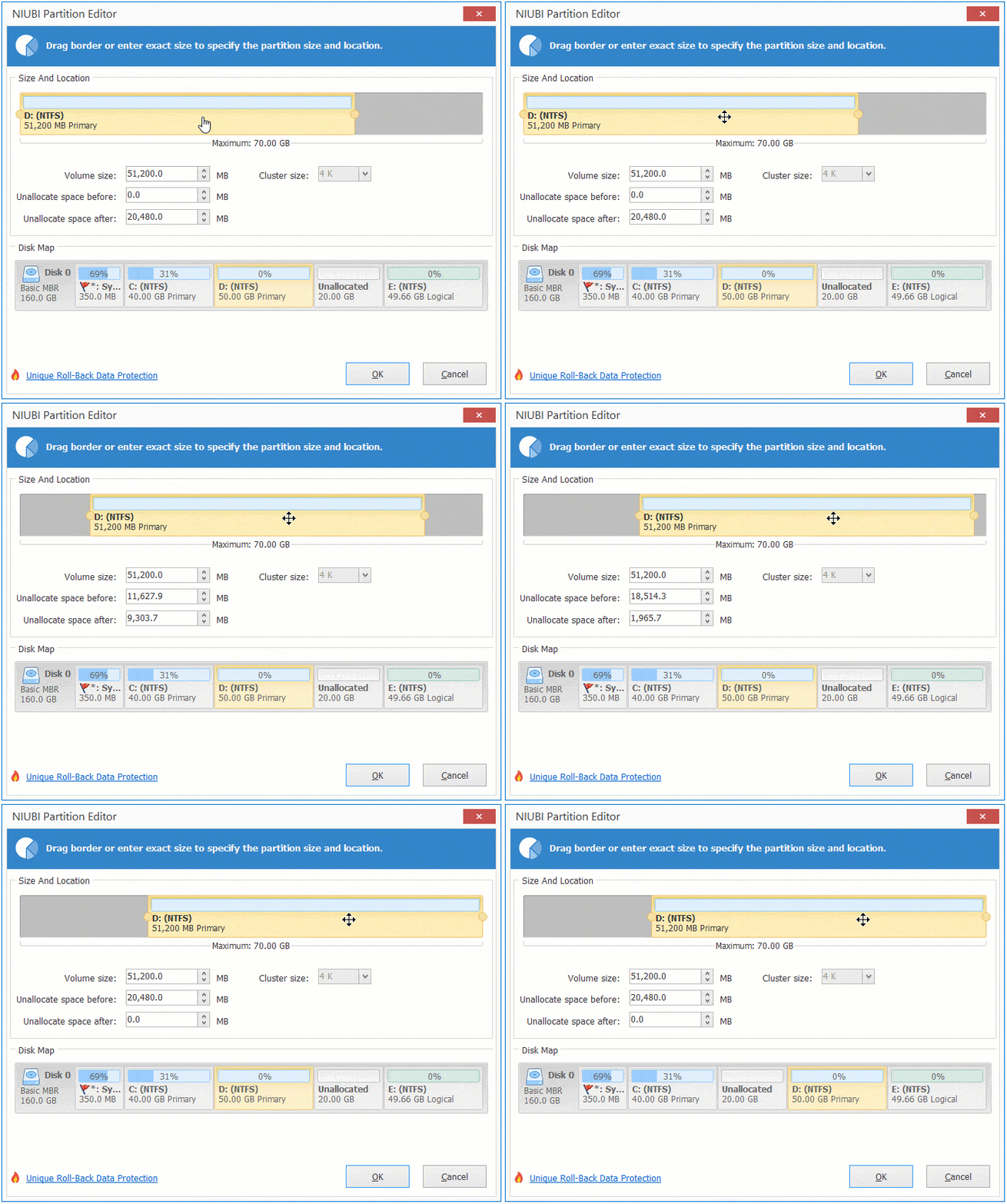
Then, the D drive is moved to the right, and the unallocated space is moved to the left side.
Step 2: Right click C: drive and select "Resize/Move Volume" again, drag the right border to the right in the pop-up window.
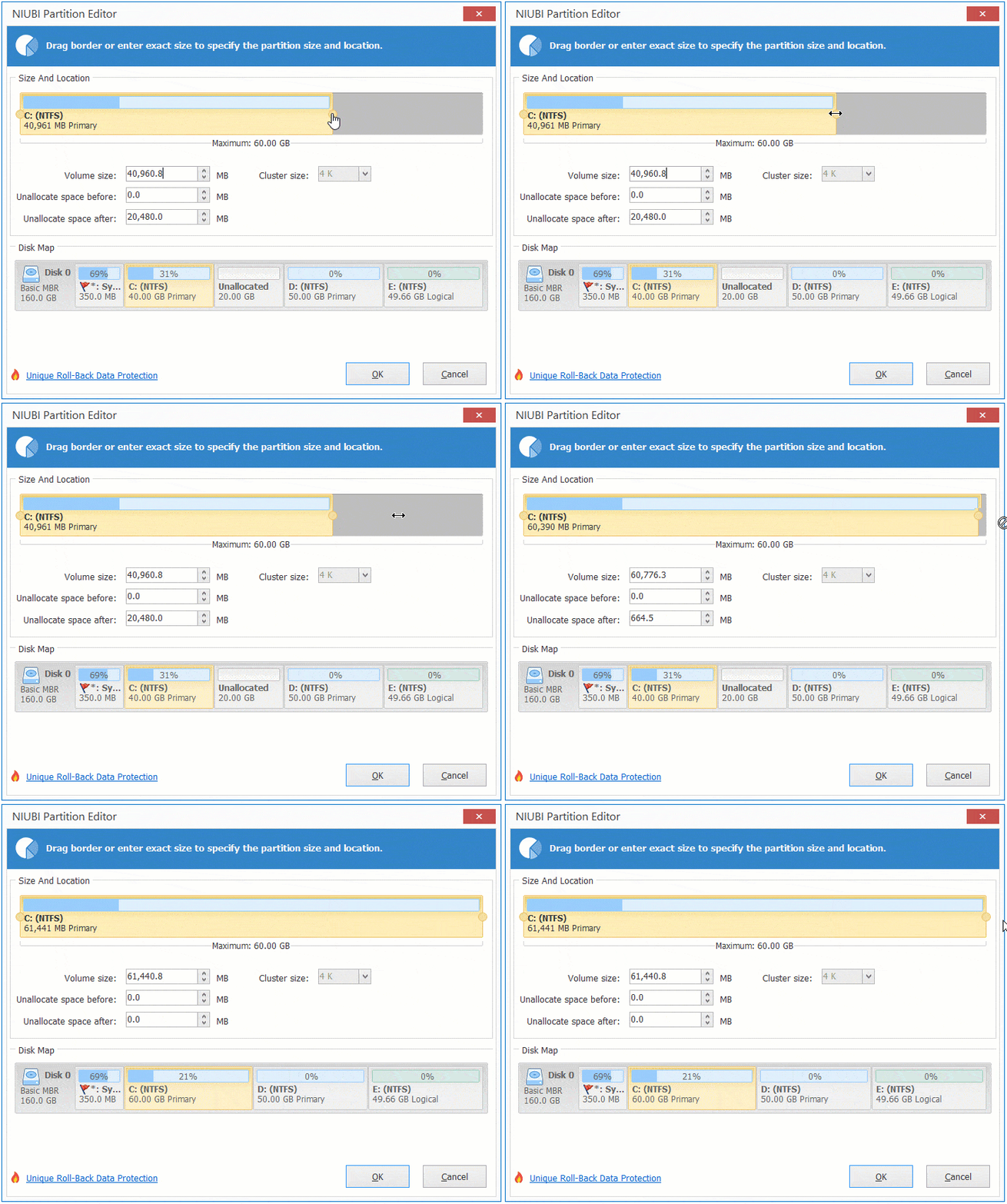
Then, the unallocated space is merged into the C: drive.
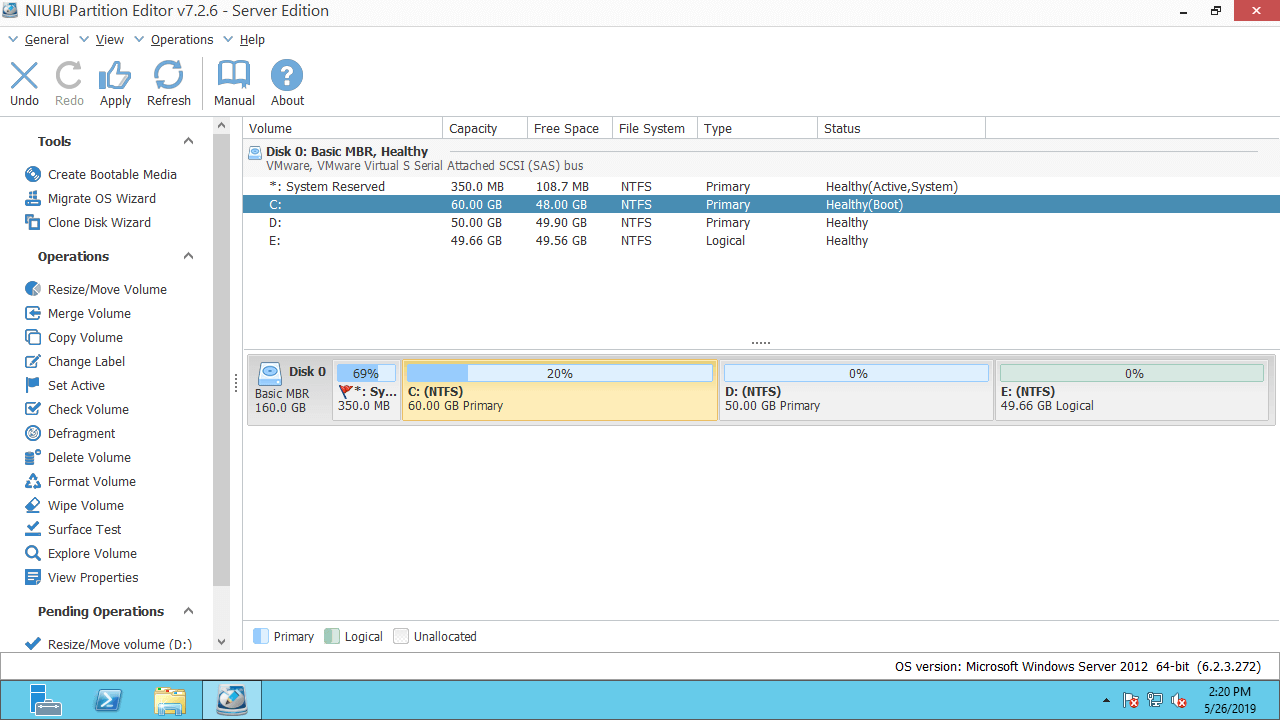
Step 3: Click "Apply" on top left to take effect. (All operations before this step only work in virtual mode.)
Watch the video below to see how to move unallocated space and add it to the C drive:
Steps when you cannot extend C drive in Server 2012 R2 after deleting D:
- Recreate this partition with Windows Disk Management.
- Shrink or delete this partition to get unallocated space with NIUBI Partition Editor. Make unallocated space on the left if you want to shrink this partition.
- Right click C drive and merge unallocated space with "Resize/Move Volume".
Steps when you cannot extend a partition past 2TB in Windows Server 2012:
- Follow the steps to convert MBR disk to GPT.
- Run NIUBI Partition Editor to merge or move unallocated space to the C drive.
Better than other software, NIUBI Partition Editor features unique technologies like Hot Clone, 1-Second Rollback, Cancel-at-Will, and Virtual Mode to protect your system and data. Besides shrinking, moving, and extending partitions, it helps you perform many other disk partition management operations.
 © 2009 - NIUBI Technology All Rights Reserved. |